

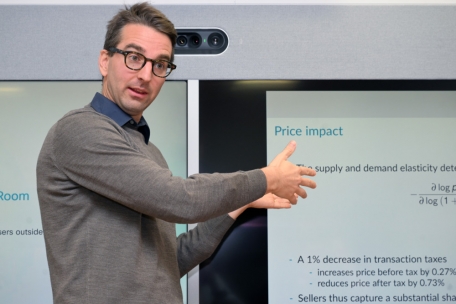
This week, we had the wonderful opportunity to give back by mentoring the next generation of professionals.
Invited by François Koulischer at the University of Luxembourg, we shared our experiences and the valuable lessons we learned along the way.
Often, we hesitate to acknowledge our mistakes, yet it is precisely these experiences that enrich our knowledge. They are the costs we incur in pursuit of our goals—the very goals that fuel our dreams. Without clear objectives, dreams can remain just that—dreams that ultimately lead to disappointment.
The students in the Money, Credit, and Banking course were eager to understand how these lessons can address challenges related to wealth transition, impact measurement in investing, and building endowment-style portfolios.
We commend their curiosity and dynamism across all pathways. Ultimately, it is essential to recognize, admit, learn from, and then move on from our mistakes. While they can be costly, the students grasped that learning from others’ experiences can be even more valuable and far less painful.
The students have for already work experience and from institutional and private sector entities in the finance domain. During our interactive work session, we covered essential topics such as:
- Institutional processes of wealth management and how they can be applied to private investment offices.
- Diversity in family offices purposes, operating processes and governance.
- Best practices for next generation involvement into the family business, or family office.
- Sustainable investing, focused on measuring impact.
- Foundations and endowments, and how the European market offers a variety of tools.
- Income approach and value-based investing, after having quantified the goals once we distinguished the needs.
- Strategic asset allocation, and the interplay with the capital market assumptions.
- Importance of an investment policy statement, and how one can interact with an outsourced CIO or delegate certain investment functions.
The students demonstrated remarkable enthusiasm, actively engaging with questions about investment theses, specific investment hurdles, scenario analysis, stress testing, benchmarking, and leverage. They also expressed interest in alternative strategies, including hedge funds.
When considering talent retention and the structure of a family office, several nuanced factors must be kept in mind to ensure a high-performing, sustainable, and future-proof organization.
Talent Retention in Family Offices
Retaining talent in a family office is distinct from other financial institutions due to the unique culture, values, and long-term orientation of these organizations. Critical considerations include:
- Providing clear long-term incentives and competitive compensation, aligned with both performance and family values, such as equity participation or co-investment opportunities.
- Fostering a sense of trust and purpose by involving key professionals in strategic decision-making, ensuring they understand their impact on both wealth preservation and family legacy.
- Emphasizing professional development, mentorship, and opportunities for upskilling, particularly given the close-knit nature of family office environments.
- Ensuring a supportive culture that allows for a healthy work-life balance and recognizes the non-monetary motivations of talented professionals.
Family Office Structure: Key Areas
Family offices can take on various structures—from single-family to multi-family offices, from operationally active to investment-led entities. Essential topics to manage and control in these structures include:
- Governance: Clearly defined roles, responsibilities, and a formalized governance framework separate oversight from management, while also accommodating evolving family dynamics.
- Risk Management & Compliance: Constant monitoring of regulatory, legal, and tax environments to safeguard assets and ensure full compliance, especially when operating cross-border.
- Succession Planning: Proactive involvement of next-generation members, supported by structured education and gradual increase in responsibility.
- Investment Oversight: Maintaining robust processes for due diligence, portfolio monitoring, and disciplined strategic allocation, including periodic reviews against the family’s documented objectives.
Essential Topics to Control
To optimize operations, manage risks, and achieve long-term goals, a family office must exert strong oversight in the following areas:
- Investment policy and strategy: Regularly review and adhere to the investment policy statement (IPS), adjusting strategic allocations as market conditions and family objectives evolve.
- Cost control and transparency: Maintain clear reporting on both direct and indirect costs to ensure efficiency and alignment with the family’s vision.
- Outsourced relationships: Monitor third-party managers, outsourced CIOs, and advisors to ensure their mandates remain suitable and aligned with family values.
- Cybersecurity and data privacy: With sensitive financial and personal information at stake, stringent controls must be in place.
- Philanthropy and impact measurement: Develop formal structures for charitable giving that align with family values, regulatory requirements, and measurable social impact.
Conclusion
By prioritizing these aspects—talent retention, strong governance, risk management, generational transition, and robust operational controls—a family office can support both enduring wealth and the flourishing of each family member’s legacy.